How rTMS can affect brain activity
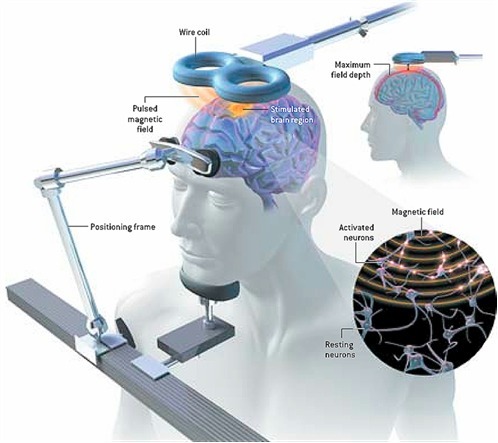
No, rTMS is not a not a new type of MS, but stands for repetitive Transcranial Magnetic Stimulation. Basically it’s a way of stimulating the cerebral cortex with the help of electromagnetic fields. The reason rTMS caught my attention is because of its ability to reactivate nerve cells. As you may have noticed, my main interest lies in research concerning multiple sclerosis (MS), which is caused by the breakdown of the myelin layer protecting the nerve cells. When this layer is removed, electric pulses can’t be transferred through the nerve cells anymore, causing certain muscles to paralyse. Unfortunately, rTMS is not the answer to this problem, since it cannot induce the formation of myelin or stop its breakdown. Yet, rTMS has shown to be effective as a treatment for other neuronal disorders such as depression, obsessive compulsive disorders and posttraumatic stress disorders.
Lets get down to physics.
In order to explain how rTMS works, I need you dig deep and recall Faraday’s induction law. This law looks a little likes this: U = -N(dΦ/dt), with U the induced voltage (in volts), N the amount of turns of the used coil, t the passed time (in seconds), and Φ the magnetic flux (in weber). In other words, a very complicated law to express how a coil in a constantly changing magnetic field (represented by the flux over time) induces an electric current. What’s interesting about this law is the fact that you can turn this entire thing around by running a current with constantly changing amperage through the coil, causing a magnetic field. This is the principal rTMS is based on. This magnetic field can easily pass your skull and reach your nerve cells, where again Faraday’s induction law is of use. Here the constantly changing magnetic field (the reason the signal needs to be repetitive) induces a current, mimicking the pulses which are normally sent out by other nerve cells. This can reactivate brain activity when your body fails to do so itself.
As a biochemist, I don’t especially care much for physics. Still, as rTMS is the perfect example, physics matters. Does this mean all researchers should have a flawless knowledge of physics and every other science discipline? That would be a tad too much work for one person. What makes science, at least in my eyes, so much fun is working together in research teams consisting of people with knowledge of different fields. Everybody can contribute a piece to the giant puzzle called life.
 My Science Interests