The cellular changes of multiple sclerosis.
When it comes to multiple sclerosis (MS), there are lots of different cell-types damaging your nerve cells, most of them being myeloid cells. Some of these myeloid cells occupy your central nervous system (CNS), such as microglia and CNS-associated macrophages (CAMs). Both of these cells play a role in maintaining homeostasis. Other myeloid cells, immune cells like monocytes and dendritic cells, start to invade your CNS at the early stages of MS or experimental autoimmune encephalomyelitis (EAE). Also lymphocytes are involved in the breakdown of your nerve cells.
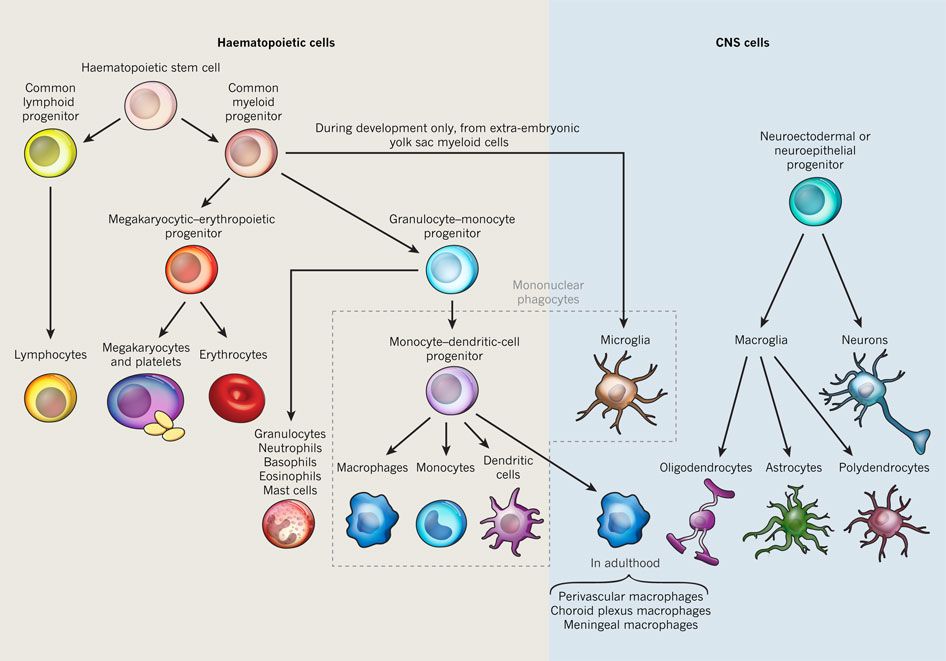
Now, what used to be quite difficult to explain was the role of the CNS-resident CAMs and microglia when it comes to MS progression. A study by Jordão et al. (link: https://science.sciencemag.org/content/363/6425/eaat7554) used single-cell transcriptional profiling (scRNA-seq) and transgenic mouse lines to solve this problem.
Jordão and her colleagues found a clear difference between homeostatic and disease-associated myeloid cells. About disease-associated microglia, they found that these cells reproduced way more often than homeostatic microglia. The disease-associated CAMs showed higher levels of antigen MHC class II. This suggested that they could recruit lymphocytes. This hypothesis, however, was thrown out after Jordão saw no change in the disease course or severity when they got rid of the MHC class II machinery in CAMs and microglia of transgenic mice. Only when this machinery was removed from both CNS-resident and peripheral myeloid cells did the mice become resistant to EAE. This gave the new insight that recruiting lymphocytes is the main job of the invading myeloid cells.
What you’re probably thinking is: “Now what?”. Let me tell you what this all means.
All the above gives an idea of the disease course of MS. In the early stages, invading myeloid cells, such as monocytes, are crucial for antigen presentation so that lymphocytes are recruited. But in the later stage of MS, it’s the microglia who start to gain in numbers. This makes it possible for new therapies to not only be adjusted to the stage of MS, but also to target different cellular processes and responses.
No matter how confusing all these different cell-types can be, it’s essential to understand the role of every single one of them. Only then can we aim for specific cells in treatments, while also have fewer side effects, making the treatment more comfortable.
Source: https://www.nature.com/articles/s41582-019-0165-5
More info on:
- The role of microglia and CAMs in homeostasis: https://www.nature.com/articles/nri.2017.125
- Single-cell transcriptional profiling (aka single-cell RNA sequencing or scRNA-seq): https://www.youtube.com/watch?v=tlf6wYJrwKY
- Transgenic mouse lines: https://www.genetargeting.com/transgenic/what-are-transgenic-mice/
- The MHC class II machinery (major histocompatibility complex) in myeloid cells: https://www.youtube.com/watch?v=TMnkihN6zVM
Latest posts:
 My Science Interests