How multiple sclerosis evolves from bad to worse, and the research behind this statement.
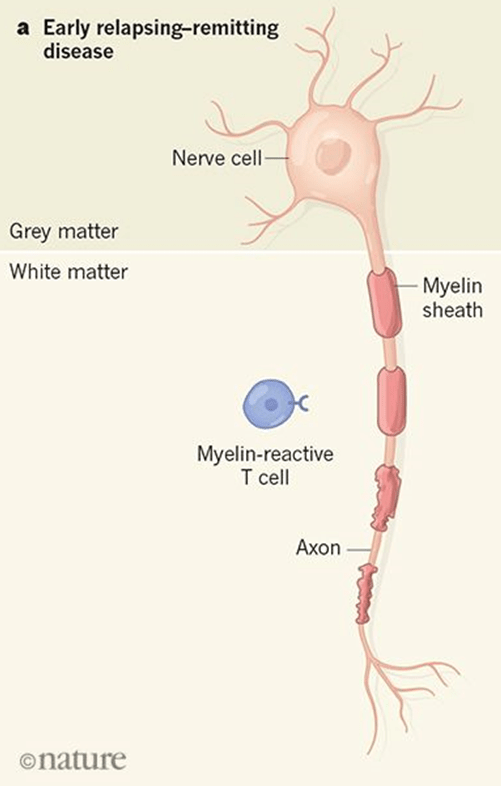
As you may know, multiple sclerosis (MS) is an autoimmune disease characterized by the destruction of nerve cells, and is usually diagnosed at an early stage called ‘relapsing-remitting multiple sclerosis’ (RRMS). In this stage you would experience unpredictable periods of symptoms followed by periods in which the symptoms fade. A lot of progress has been made in finding what exactly happens in your body at this stage, by using a mouse model called experimental autoimmune encephalomyelitis (EAE). Nowadays, it’s generally known that immune cells, mainly your T cells and macrophages, attack the white matter in your brain and spinal cord. The main target of your immune cells is a mixture of lipids and proteins named myelin, which protects your nerve fibres or axons of your nerve cells. The breakdown of this protective layer affects the transfer of signals, causing the typical symptoms of RRMS.
RRMS often leads to the next stage, the progressive stage, where your nerve cells gradually start to lose their function. New research, by Lodygin and colleagues (link: https://www.nature.com/articles/s41586-019-0964-2), suggests that this might be linked to the damaging of your nerve cells in the grey matter region.
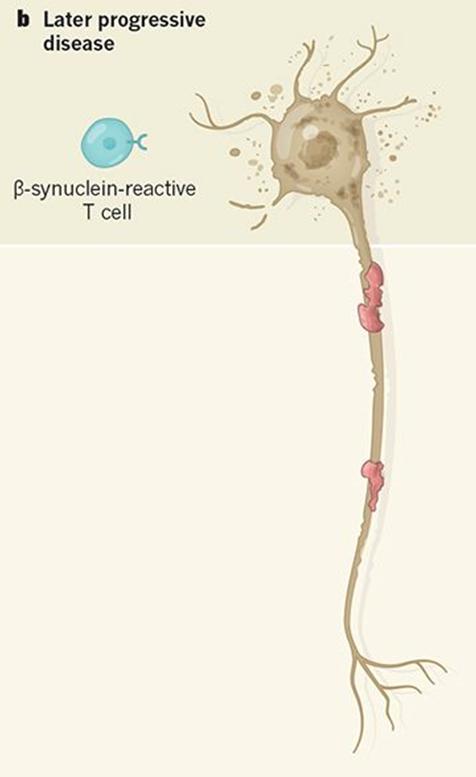
In contrast to white matter, grey matter doesn’t contain myelinated axons, but your nerve cells’ cell bodies. These cell bodies contain the genetic material and are essential for the processing of signals. The breakdown of this cell-part is probably what causes your nerve cells to lose their function. Lodygin and his colleagues used a rat model to compare different kinds of migrating T cells: those that target myelin and those that recognize a protein called β-synuclein. This protein is typically present in the junctions between your nerve cells, which we like to call synapses, and has the purpose of regulating endocytosis (basically that which allows your cells to eat and drink). This study confirmed that myelin-reactive T cells are present in your myelin-rich white matter and that T cells that recognize β-synuclein cause permanent damage mainly in your grey matter. So we can conclude that β-synuclein might be a late-stage autoimmune target.
This expansion of our knowledge in the everything but black and white world of MS sets the tone for other researchers to either do more research on this subject or on the development of a new treatment. Either way, there’s lots of possibilities and opportunities here. But when it comes to future hypotheses, your guess is as good as mine.
Source: https://www.nature.com/articles/d41586-019-00563-6
Latest posts:
 My Science Interests